
Van Dusen Capital
Indexed Universal Life vs 401(k)
Understanding Retirement Plans vs Wealth Strategies
For decades, the 401(k) has been the backbone of retirement planning in the United States. It is often the first—and sometimes only—strategy people are taught to rely on.
But as markets fluctuate, taxes evolve, and retirement timelines shift, many individuals begin to question whether a 401(k) alone is enough.
Indexed Universal Life (IUL) introduces a different approach—one focused on flexibility, control, and long-term positioning rather than just accumulation inside a retirement account.
Quick Comparison: IUL vs 401(k)
| Category | 401(k) | IUL |
|---|---|---|
| Tax Treatment | Tax-deferred | Potential tax-advantaged access |
| Market Exposure | Direct market risk | Indexed (no direct investment) |
| Access to Funds | Restricted / penalties | Policy-based access |
| Employer Dependency | Yes | No |
| Flexibility | Limited | High (when structured properly) |
IMAGE PLACEHOLDER: IUL vs 401k Overview
How a 401(k) Works
A 401(k) is an employer-sponsored retirement plan that allows individuals to contribute pre-tax income into investment accounts. Contributions may be matched by an employer depending on the plan.
Key characteristics:
- Contributions reduce taxable income today
- Investments grow tax-deferred
- Withdrawals are taxed as income later
- Funds are typically locked until retirement age
The 401(k) is designed for long-term retirement accumulation under tax-deferred rules.
How IUL Differs
Indexed Universal Life is not a retirement account. It is a life insurance strategy with a cash value component that may grow over time.
Key differences:
- Not tied to employer plans
- Flexible funding
- Indexed growth strategies
- Access based on policy structure
It operates outside the traditional retirement system.
IMAGE PLACEHOLDER: Retirement Plan vs Strategy
Tax Now vs Tax Later
401(k) contributions reduce taxes today, but withdrawals in retirement are taxed as ordinary income.
This creates uncertainty because future tax rates are unknown.
IUL strategies are often discussed in the context of tax-advantaged growth and access, depending on structure.
The key question becomes: when do you want to pay taxes—now or later?
Market Risk and Volatility
401(k) accounts are typically invested directly in the market. This means account values rise and fall with market performance.
Market downturns can impact retirement timelines, especially if losses occur near withdrawal years.
IUL uses indexed strategies that track market performance without direct investment, often including downside protection features depending on policy design.
This creates a different experience during market volatility.
Access and Restrictions
401(k) plans are designed for retirement. Accessing funds early may result in penalties and taxes depending on circumstances.
IUL strategies may allow access to capital based on policy structure and accumulated value.
Flexibility in access can impact how a strategy functions over time.
IMAGE PLACEHOLDER: Access vs Restriction
Sequence of Returns Risk
One of the biggest risks in retirement planning is sequence of returns risk—when market losses occur at the wrong time.
If a 401(k) experiences a downturn during early retirement years, it can significantly impact long-term income sustainability.
Strategies that reduce or manage this risk can play an important role in financial planning.
Common Misconceptions
“401(k) is all I need.”
It is one tool, but not necessarily a complete strategy.
“IUL replaces my 401(k).”
It is often used as a complement, not a replacement.
“Taxes will be lower later.”
Future tax rates are uncertain.
Real-World Scenario
An individual contributes to a 401(k) for 30 years. Their balance grows—but remains exposed to market fluctuations and future taxation.
At retirement, they must begin withdrawing funds under tax rules and potentially required distributions.
Alternative strategies may be explored to complement or balance this structure.
Build Beyond Retirement Plans
A retirement account is a tool. A strategy is a system.
Van Dusen Capital
Indexed Universal Life vs 401(k)
Tax Deferral, Market Risk, and Long-Term Control
The 401(k) has become the default retirement vehicle for millions of Americans. It offers tax deferral today, potential employer matching, and long-term market participation. But it also introduces constraints—on access, taxation, and timing—that can shape outcomes decades later.
Indexed Universal Life (IUL) is not a retirement account. It’s a life insurance-based strategy that can be structured for flexibility, potential tax advantages, and access to capital—operating outside employer plan rules.
This page compares how each system behaves over time so you can evaluate cost, control, and continuity—not just contribution.
IMAGE PLACEHOLDER: IUL vs 401k Overview
401(k): Tax Deferral Inside an Employer Plan
A 401(k) allows you to contribute pre-tax income into a retirement account. Contributions reduce taxable income today, and investments grow tax-deferred until withdrawal.
Core characteristics:
- Pre-tax (traditional) or after-tax (Roth 401(k)) options depending on plan
- Employer match (varies by employer and plan rules)
- Market-based investments (mutual funds, ETFs, target-date funds)
- Withdrawals taxed as income (traditional 401(k))
- Access generally restricted until retirement age
The 401(k) is designed to accumulate assets over time within a rules-based system.
Internal link cue: see “Why 401(k)s May Not Be Enough.”
IUL: Structure Outside Employer Constraints
Indexed Universal Life is a permanent life insurance policy with a cash value component. When designed with an accumulation focus, it can be positioned to prioritize flexibility and long-term access.
Core characteristics:
- Not tied to an employer or job status
- Flexible funding within policy design limits
- Indexed crediting strategies (market-linked, not directly invested)
- Access to value based on policy structure
Because it sits outside retirement-plan rules, IUL can be used alongside 401(k)s rather than replacing them.
Internal link cue: see “How Policy Loans Work” and “Tax Advantages of Life Insurance.”
IMAGE PLACEHOLDER: Plan vs Strategy
Employer Match: Benefit vs Dependency
Employer matching can be a powerful feature of 401(k) plans. In many cases, contributing up to the match threshold can be an efficient first step.
However, the match:
- Depends on employer policy
- May have vesting schedules
- Can change if employment changes
This introduces a dependency on employment that may not align with long-term flexibility.
IUL is independent of employer plans, which removes that dependency—but also removes the match. Each has trade-offs.
Tax Now vs Tax Later (and Unknown Future Rates)
Traditional 401(k) contributions reduce taxable income today, but withdrawals are taxed as ordinary income later. This creates uncertainty because future tax rates are unknown.
Roth 401(k) options reverse this (tax now, tax-free later), but still operate within plan rules and limits.
IUL strategies are often discussed in the context of tax-advantaged growth and access, depending on policy design and compliance.
The key decision is not just tax deferral—it’s tax timing and control across decades.
Market Exposure and Sequence of Returns Risk
401(k) accounts are typically invested directly in the market. This means full participation in both gains and losses.
Sequence of returns risk occurs when market losses happen near or during retirement, which can impact how long assets last when withdrawals begin.
IUL uses indexed crediting strategies (policy-specific) that track market performance without direct investment and may include a 0% floor concept designed to limit downside from market declines.
Internal link cue: see “Sequence of Returns Risk Explained” and “0% Floor Protection Explained.”
IMAGE PLACEHOLDER: Volatility vs Stability
Access, Penalties, and Required Distributions
401(k) plans are designed for retirement access. Early withdrawals may trigger taxes and penalties depending on age and circumstances.
Additionally, traditional 401(k)s are subject to Required Minimum Distributions (RMDs), which mandate withdrawals starting at a certain age under IRS rules.
IUL strategies may allow access to value based on policy structure and available cash value, without RMD requirements in the same way.
This affects how income can be managed later in life.
Illustrative 30-Year Comparison (Conceptual)
Two individuals contribute consistently for 30 years:
Individual A:
- Contributes to a 401(k)
- Receives employer match
- Experiences market gains and losses
- Withdraws in retirement with taxes due
Individual B:
- Builds a structured IUL strategy
- Positions capital for long-term accumulation
- Uses indexed crediting approaches
- Accesses value based on policy structure
Outcomes will vary based on markets, policy design, and behavior—but the structure of each strategy leads to different trade-offs in tax treatment, access, and risk.
This is a conceptual comparison, not a guarantee of results.
Strategy Stacking: Using Both Together
A common approach is to combine strategies:
- Contribute to a 401(k) up to employer match
- Add additional strategies to increase flexibility and control
This can create:
- A tax-deferred bucket (401(k))
- A flexible strategy bucket (IUL)
Diversifying across structures can reduce reliance on any single system.
Common Misconceptions
“My 401(k) is enough.”
It is one tool, but may not address all long-term variables.
“IUL replaces my 401(k).”
It is often used as a complement, not a replacement.
“Taxes will be lower in retirement.”
Future tax rates are uncertain and can change over time.
“Market returns average out.”
Averages don’t eliminate timing risk when withdrawals begin.
Expanded FAQ
Should I stop my 401(k)?
Decisions depend on your goals, employer match, and overall plan.
Is the employer match “free money”?
It can be valuable, but it comes with plan rules and long-term tax implications.
Which has more flexibility?
IUL generally offers more flexibility; 401(k) offers structure and simplicity.
What about RMDs?
Traditional 401(k)s have RMD rules; IUL does not operate under the same requirement.
Can I use both?
Yes—many plans use multiple strategies to balance trade-offs.
Biggest Mistakes People Make With 401(k)s
A 401(k) can be a valuable retirement tool, especially when an employer match is available. The mistake is not using a 401(k). The mistake is assuming a 401(k) automatically solves every retirement problem.
- Relying on one tax-deferred bucket for nearly all retirement income
- Ignoring how future tax rates could affect withdrawals
- Assuming market growth will always line up with retirement timing
- Not understanding restrictions on access before retirement age
- Contributing without a broader tax, liquidity, and protection strategy
The goal is not to avoid 401(k)s. The goal is to avoid building your entire retirement strategy around one tool.
Sequence of Returns Risk: Why Timing Matters
Sequence of returns risk refers to the danger of experiencing poor market returns early in retirement, especially when withdrawals have already started. Even if long-term average returns look strong, the order of those returns can dramatically affect how long money lasts.
For someone relying heavily on a 401(k), a major market decline near or during retirement can create pressure. Withdrawals may need to continue while account values are down, which can force a person to sell investments at the wrong time.
This is one reason some people look for additional financial buckets outside traditional retirement accounts. A properly structured IUL may offer an additional source of accessible value, which could help reduce pressure on market-based accounts during difficult periods.
This does not mean IUL replaces market investing. It means retirement income planning should consider timing, access, taxes, and risk together.
IMAGE HERE — Sequence of returns risk visual
File: sequence-of-returns-risk-iul-vs-401k.webp
Alt: Sequence of returns risk comparison showing market downturn impact and protected capital strategy
The Future Tax Problem: Tax Deferral Is Not Tax Elimination
One of the biggest misunderstandings about 401(k)s is the difference between tax deferral and tax elimination. A traditional 401(k) may reduce taxable income today, but withdrawals are generally taxed later.
That means the question becomes: will your future tax situation be better, worse, or unknown? Many people contribute for decades without fully considering what happens when every withdrawal becomes taxable income.
This is sometimes called the “tax time bomb” problem. The account balance may look large, but the entire balance is not necessarily yours to spend. Taxes may be due when income is taken.
- 401(k) contributions may create tax deferral today
- Withdrawals may create taxable income later
- Required distributions can affect retirement tax planning
- Taxable withdrawals may influence Social Security taxation and Medicare-related costs
An IUL strategy, when properly structured and maintained, may provide a different tax profile through policy loans and withdrawals. The key is proper design and ongoing management.
IMAGE HERE — Real numbers comparison chart
File: iul-vs-401k-real-numbers-comparison.webp
Alt: Real numbers comparison chart for IUL vs 401k showing taxes access risk and protection
Why Strategy Stacking Can Be More Powerful Than Choosing One Side
The strongest answer is not always “401(k) or IUL.” For many people, the stronger conversation is how to use both correctly.
A person may use a 401(k) for employer match and long-term retirement accumulation while also using IUL for protection, flexibility, and policy-based access. This creates more than one financial bucket.
- A tax-deferred bucket through a 401(k)
- A flexible policy-based bucket through IUL
- A protection layer through life insurance
- A liquidity strategy that is not fully dependent on market timing
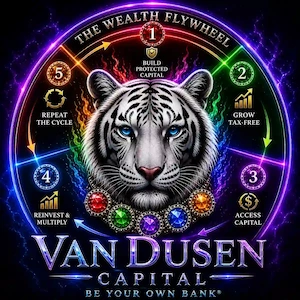
This is the heart of The Wealth Flywheel System: build protected capital, grow tax-free, access capital, reinvest and multiply, then repeat the cycle with intention.
Build a Strategy Beyond One Retirement Account
Your retirement plan should not depend on one account, one tax treatment, or one market outcome. Let’s look at whether a structured IUL strategy belongs beside your current retirement plan.