
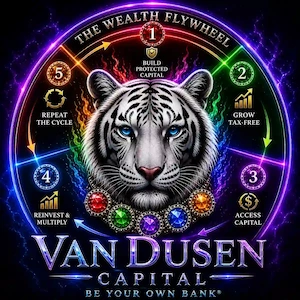

Van Dusen Capital • The Wealth Flywheel System
The Wealth Flywheel System: Advanced Strategy
This is where strategy replaces theory. The Wealth Flywheel System is not just a concept — it is a structured approach to building, accessing, and multiplying capital over time.
If you have not reviewed the foundation yet, start with The Wealth Flywheel System overview before diving into advanced strategy.
What Makes This an Advanced Strategy
Most financial advice focuses on saving, investing, and hoping for long-term growth. The Wealth Flywheel System shifts that approach toward control, flexibility, and intentional capital use.
At the advanced level, the goal is no longer just accumulation. It is about how capital moves, how it is accessed, and how it is reused.
This system often integrates strategies explained in how max-funded IULs work and expands them into a repeatable cycle.
The advanced strategy focuses on optimizing each step of the cycle rather than treating them as separate actions.

Step 1: Advanced Capital Positioning
At the foundational level, Step 1 is about building protected capital. At the advanced level, it becomes about positioning capital efficiently from the start.
This includes structuring policies properly, avoiding inefficiencies, and aligning funding with long-term goals. Many mistakes happen here, which is why reviewing common IUL mistakes is critical.
Advanced positioning means thinking ahead — not just about growth, but about future access and flexibility.
Step 2: Optimizing Tax-Advantaged Growth
Growth is not just about returns — it is about how those returns are structured and protected.
Indexed strategies allow participation in market performance while avoiding direct downside exposure. Learn more in indexed growth explained .
Advanced strategy involves understanding how caps, participation rates, and timing affect long-term outcomes.
Over time, consistency and structure matter more than chasing maximum returns.

Step 3: Advanced Capital Access
Step 3 is where The Wealth Flywheel System becomes powerful. Once capital has been built and allowed to grow, the next question becomes: how can that capital be accessed without destroying the long-term strategy?
In a properly structured max-funded IUL, policy loans may allow access to cash value while the policy remains active. This is very different from selling an investment, taking taxable retirement distributions, or asking a bank for permission.
The key is understanding the difference between access and withdrawal. A withdrawal removes money from the policy. A policy loan uses the policy value as collateral. Learn the deeper mechanics here: how policy loans work .
Advanced Strategy Point
Capital access is not about draining the policy. It is about using liquidity strategically while preserving the long-term engine of the system.
Step 4: Reinvesting Capital With Purpose
Step 4 is where accessed capital can be redeployed. This is why The Wealth Flywheel System is different from a simple savings plan. The goal is not only to store money. The goal is to position capital so it can be used again with intention.
Advanced users may apply this strategy toward business opportunities, real estate, equipment, marketing, education, emergency liquidity, or other wealth-building uses. The goal is always the same: use capital in a way that supports long-term growth instead of short-term consumption.
Business owners can study this further in IUL for business owners , while real estate-focused readers should review using IUL for real estate investing .
The advanced move is not just accessing money. The advanced move is using that access to build another layer of wealth, income, or opportunity.
Step 5: Repeating the Cycle
Step 5 is what turns the strategy into a flywheel. A flywheel gains strength through repetition. The same concept applies financially. Protected capital is built, growth is credited, capital is accessed, capital is redeployed, and the cycle continues with discipline.
This is why The Wealth Flywheel System is not just about one financial product. It is a method for thinking about money. Instead of using capital once and losing control of it, the goal is to create a structure where money can keep moving through a controlled system.
This connects directly to the broader concept of becoming your own source of capital. For a simple version, review Be Your Own Bank using IUL .
The Repeat Cycle
Build protected capital. Grow tax-advantaged. Access strategically. Reinvest with purpose. Repeat the cycle with review, discipline, and long-term planning.

Advanced Strategy in Action: Real-World Example
Understanding the structure is important. Seeing how it plays out in real life is where it clicks.
Consider a business owner earning consistent income who wants more control over their capital. Instead of relying entirely on traditional retirement accounts, they implement a max-funded IUL strategy aligned with how max-funded IULs work .
Over time, they build protected capital, allow it to grow, and eventually begin using policy loans for opportunities — while keeping the long-term structure intact.
What Changed
- Capital became accessible without traditional restrictions
- Growth remained protected from market losses
- Opportunities could be pursued without disrupting the system
- Money was used more than once instead of once
This is the difference between saving money and controlling capital.
Real-World Example: The Wealth Flywheel in Action
Understanding the strategy is one thing. Seeing how it works in real life is where everything starts to click.
Consider a business owner earning consistent income who wants more control over their capital and fewer limitations on how it can be used. Instead of relying entirely on traditional retirement accounts or outside financing, they implement a properly structured max-funded IUL as part of their overall financial strategy.
Over time, they begin building protected capital while allowing it to grow in a tax-advantaged environment. As the cash value increases, they gain the ability to access capital through policy loans without interrupting the long-term structure of the system.
Instead of stopping the cycle to use money, they are able to continue the cycle while using capital strategically — whether for business expansion, opportunities, or personal needs.
What Changed
- Capital became accessible without traditional restrictions or approvals
- Growth continued without exposure to market loss
- Opportunities could be pursued without stopping long-term compounding
- Money was used more than once instead of once
This is the difference between simply saving money and actually controlling how your capital works over time.

Strategy, Not Sales
One of the biggest mistakes people make is thinking this is about buying a policy. It is not. It is about building a system.
The same policy can produce very different outcomes depending on how it is structured, funded, and used over time. That is why education matters first.
This is also why reviewing common IUL mistakes is essential before implementing any strategy.
Built on Real Financial Principles
The Wealth Flywheel System is not based on theory or trends. It operates within established financial, insurance, and tax frameworks.
- IRS guidance on life insurance taxation: IRS.gov
- Consumer protections and policy standards: NAIC
- Financial industry oversight: FINRA
These frameworks help ensure that the strategy is grounded in structure — not marketing.

Build Your Wealth Flywheel Strategy
If you want to see how this strategy would work based on your income, goals, and timeline,
the next step is a personalized strategy session.
If you’ve found this information valuable and would like to support our educational work,
we sincerely appreciate it.
Cash App: $vandusencapital
Your support helps us continue creating high-quality financial education and resources.
What Separates Beginner Strategy From Advanced Strategy
Most people approach financial planning with a simple mindset: earn, save, invest, and wait. That approach can work, but it often lacks flexibility and control.
The advanced version of The Wealth Flywheel System shifts the focus from accumulation to capital efficiency, access, and reuse.
Instead of asking “How much can this grow?”, the better question becomes: “How many times can this capital be used?”
This concept connects directly to strategies like infinite banking , where control over capital becomes a long-term advantage.
The Role of Control in Long-Term Wealth Building
One of the biggest differences between traditional planning and advanced strategy is control. Traditional systems often lock money away, limit access, or require penalties to use your own capital.
The Wealth Flywheel System is built around the idea that capital should remain usable. That does not mean using it recklessly — it means maintaining access without collapsing the structure.
This is why many people explore strategies like becoming your own bank , where access and control are built into the system itself.
Advanced Insight
Control is not about avoiding structure. It is about designing structure that works for you, not against you.

How This Connects to Long-Term Income Strategy
The Wealth Flywheel System is not just about growth — it is about creating future income flexibility.
Instead of relying entirely on taxable distributions, some individuals use structured access strategies to help manage how and when income is taken.
This is explored further in tax-free retirement strategies using IUL and building passive income using IUL .
The goal is not just income — it is flexibility, timing, and control over how that income is created.

Van Dusen Capital • The Wealth Flywheel System
The Wealth Flywheel System: Advanced Strategy
This is where strategy replaces theory. The Wealth Flywheel System is not just a concept — it is a structured approach to building, accessing, and multiplying capital over time.
If you have not reviewed the foundation yet, start with The Wealth Flywheel System overview before diving into advanced strategy.