
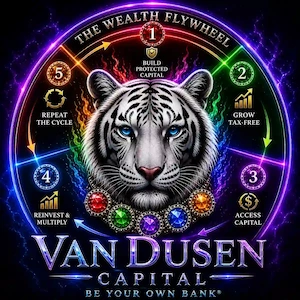
Cover While I’m Living – A Message Most People Miss Until It’s Too Late
There are phrases that sound simple until you actually understand what they mean.
“Cover while I’m living” is one of those phrases. Most people hear it and think it is just clever wording. But when you slow down and think about it, it exposes one of the biggest blind spots in traditional financial planning.
The reality is this: financial pressure rarely starts at death. It often starts while you are still here, still responsible, still expected to provide, but potentially limited in your ability to do so.
That is why this message matters. Life insurance should not only be explained as something that helps people after death. When structured correctly, it may also help create protection, options, and flexibility during life.
Image Placement: Hero Visual
Place this image directly under the hero section.
Image Prompt: Create a cinematic luxury Van Dusen Capital branded image for “Cover While I’m Living.” Show a bombshell red long-haired female agent with blue eyes wearing a metallic deep purple, icy-blue, and rainbow sparkle suit. Beside her is one white fire tiger head with glowing blue eyes and rainbow-colored flames around the head. The tiger eyes and Van Dusen Capital wordmark should match in glowing blue. Add The Wealth Flywheel System as a radiant metallic rainbow wheel in the background with five glowing segments. Theme: living benefits, family protection, income protection, emotional security, and luxury financial strategy. Include text: “Cover While I’m Living,” “Van Dusen Capital,” vandusencapital.com, and 1-618-767-0570. Premium black-purple luxury background, rainbow flame accents, no duplicate tiger heads.
File name: cover-while-im-living-van-dusen-capital.webp
Alt text: Cover While I’m Living living benefits image for Van Dusen Capital with white fire tiger and Wealth Flywheel System
Title: Cover While I’m Living – Van Dusen Capital
The Problem Most Families Never See Coming
Most financial plans are built around long-term growth. Retirement accounts, investments, savings strategies, and future income projections are often designed around the assumption that life will continue in a relatively stable way.
But stability is not guaranteed. And when instability shows up, it usually does not arrive in the form most people prepared for.
It does not always come as death. It often shows up as interruption. A health issue that slows you down. An injury that limits your ability to work. A diagnosis that shifts your entire focus. A family emergency that changes the way money needs to move.
During these moments, the financial system people built can suddenly feel fragile. Not because the plan was automatically bad, but because it may not have been built for that kind of pressure.
This is the gap most families never see coming until they are already in it.
Why This Is Not Just an Insurance Conversation
When families think about protection, they often separate insurance from the rest of their financial life. That separation is where many planning gaps begin. Life insurance is not only about a death benefit. Depending on policy design, it may also connect to family protection, living benefits, cash value potential, long-term liquidity, and tax-aware planning.
This is why Van Dusen Capital explains protection as part of a larger system. A policy should not sit alone. It should be evaluated based on how it supports the household, the income engine, the emergency strategy, the wealth-building strategy, and The Wealth Flywheel System.
For consumer education, the National Association of Insurance Commissioners provides general life insurance guidance, while Life Happens explains living benefits in simple consumer language.
What “Cover While I’m Living” Really Means
At its core, “cover while I’m living” represents a shift in thinking. It moves the conversation away from only asking, “What happens when I die?” and moves it toward a more complete question: “What happens if life changes before that?”
In certain policies, there are features often referred to as living benefits. These may allow access to a portion of the death benefit under specific qualifying conditions. Depending on the policy, those conditions may involve chronic illness, critical illness, or terminal illness.
This is not about replacing health insurance. It is not about replacing disability insurance. It is not about pretending one tool solves every problem. It is about understanding that a properly structured life insurance strategy may create another layer of potential financial access during moments when options matter most.
Understanding this changes the entire role life insurance can play inside a broader financial strategy.
The Emotional Side of Financial Protection
Financial conversations are often presented as numbers, charts, rates, projections, and policy details. Those things matter, but they are not the whole story. In real life, money is deeply emotional.
Money represents stability. It represents control. It represents time. It represents dignity. It represents the ability to make decisions without being forced into panic.
When income is disrupted, the emotional pressure often arrives quickly. People start asking how long they can keep up. They worry about bills, family needs, business responsibilities, medical costs, and whether they will have to sacrifice long-term goals just to survive the present.
That is why protection matters. Not just as a financial tool, but as a stabilizer during uncertain moments.
The goal is not fear. The goal is clarity. When people understand what they have, what they do not have, and what gaps exist, they can make stronger financial decisions before life forces the issue.
The Cost of Being Unprepared
Most people do not realize the financial impact of being unprepared until they are already in the situation. It is not just about lost income. It is about the ripple effects that follow.
Savings can get drained. Investments can be interrupted. Long-term plans can pause. Debt can increase. Business opportunities can disappear. Family stress can grow quickly.
The cost is not just financial. It is momentum. And momentum is everything when building long-term wealth.
What Happens When Income Stops But Life Doesn’t
Life does not pause when income slows down. Expenses continue. Responsibilities remain. Expectations do not disappear.
This creates one of the most difficult financial situations a person can face: being alive, but financially constrained. The person may still be present, still fighting, still healing, still trying to recover, but unable to produce income the same way for a period of time.
In these moments, people often turn to whatever resources are available. They may drain savings accounts, borrow from family, use credit cards, pause retirement contributions, pull from long-term investments, or take loans from places they never wanted to touch.
The issue is not that those tools are always wrong. The issue is that they may not have been intended for that kind of situation, which can create long-term ripple effects.
This is where having additional layers of financial access may change the outcome.
Real Scenario: Two Different Outcomes
To understand how this plays out, consider a simplified comparison.
Two individuals have similar income, similar responsibilities, and similar long-term financial goals. Both care about their families. Both want stability. Both want to build wealth. But they have different strategy structures.
Person A has some savings, a retirement account, and a basic policy focused mainly on death benefit. Person B has a coordinated strategy that includes protection, potential living benefits, and a framework connected to The Wealth Flywheel System.
Now imagine a serious health event causes income to be reduced for 12 to 24 months. Person A may need to rely heavily on savings, liquidate assets, pause contributions, or take on debt. Person B may still face pressure, but may also have additional options depending on policy design, qualification, and overall strategy structure.
The difference is not that one person avoids all problems. The difference is that one person may have more flexibility when pressure arrives.
Understanding Living Benefits in Practical Terms
When people first hear about living benefits, it can feel abstract or simplified. In reality, these features are tied to specific policy provisions, definitions, and qualification criteria that vary by carrier and structure.
Generally speaking, living benefits may allow access to a portion of the death benefit while the insured is still living if certain qualifying conditions are met. These conditions often include chronic illness, critical illness, or terminal illness as defined in the policy.
Each category has its own criteria. Chronic illness may relate to long-term care needs or inability to perform activities of daily living. Critical illness may include major medical events like heart attack, stroke, or cancer. Terminal illness may apply when a qualifying life expectancy condition is met.
These benefits are not automatic in every situation, and they are not identical across policies. That is why understanding structure matters.
Authority Check: Why Clear Explanation Matters
Living benefits should never be explained as a blanket guarantee. The specifics matter. Policy language, rider structure, qualification rules, and claim processes all determine how and when benefits may apply.
This is why responsible financial education focuses on clarity instead of hype. People should understand what their policy may do, what it may not do, and how it fits into their overall strategy.
For general consumer education, the Insurance Information Institute and Life Happens provide helpful overviews of life insurance fundamentals.
Coverage vs Strategy – Not the Same Thing
There is a fundamental difference between owning a policy and having a strategy. Coverage is something that is purchased. Strategy is something that is built intentionally.
Many people own life insurance, but they have never been shown how it fits into their financial system. As a result, the policy exists, but it may not be used to its full potential.
A strategy connects protection, growth, access, and reinvestment. It considers how each piece supports the others instead of functioning independently.
This is where The Wealth Flywheel System comes in. It is not just about owning financial tools—it is about coordinating them.
The Hidden Risk Nobody Plans For
Most financial plans assume consistency. Work continues, income continues, and long-term plans stay intact. But life does not always follow that pattern.
One of the most overlooked risks is not early death—it is living through a period where income is reduced or interrupted while responsibilities remain.
This creates a gap. Expenses continue, but income may not. Traditional strategies may not always be designed for that type of pressure.
Recognizing this risk early allows people to build more resilient financial structures instead of reacting under pressure later.
Disability Risk Is a Real Financial Factor
The Social Security Administration publishes disability data that highlights how real this risk is. Income interruption due to disability is not a rare event—it is something that affects a meaningful portion of the working population over time.
This is why planning cannot focus only on death. It must also consider what happens if income is disrupted while responsibilities remain.
You can review official data through the SSA disability statistics.
Real Life Pressure Creates Real Decisions
When unexpected events happen, people are forced to make decisions quickly. These decisions are often made under pressure, not strategy.
This may include pulling from investments early, taking on high-interest debt, pausing long-term contributions, or selling assets at the wrong time.
These are not mistakes. They are reactions. But reactions can create long-term consequences.
A structured strategy aims to reduce the need for reaction by creating options ahead of time.
Why High Earners Pay Attention to This
As income increases, so do responsibilities. High earners often carry larger obligations across family, business, and investments.
When income is disrupted at a higher level, the impact is greater. That is why high earners often focus not just on growth, but on protecting their ability to continue operating.
“Cover while I’m living” becomes a critical layer—not just a concept.
What Most People Are Never Told About This Strategy
Most people are told to “get life insurance,” but they are rarely shown how that policy is structured, what it actually does, or how it fits into their financial system. The conversation often stops at price and coverage amount.
That is where the misunderstanding begins. Because structure—not just the product—determines outcomes.
A policy can be designed primarily for protection, or it can be structured to support flexibility, access, and long-term strategy. It can include features that may provide financial access during life, or it can be limited to a death-only outcome.
That difference is not obvious unless someone explains it clearly.
Tax Treatment Is Another Reason Structure Matters
Life insurance may receive favorable tax treatment when structured and maintained properly. However, those outcomes depend on policy design, funding levels, and how the policy is used over time.
Factors such as policy loans, withdrawals, surrender activity, and Modified Endowment Contract (MEC) rules can all impact how the strategy performs. That is why this is not a “set it and forget it” decision.
Understanding these details helps people make informed decisions rather than relying on assumptions.
For official guidance, the IRS explains how life insurance proceeds are generally treated for tax purposes here: IRS Life Insurance & Disability Insurance Proceeds .
A Real Example of Structure vs Outcome
Two individuals can have similar income, similar responsibilities, and even similar types of life insurance—but completely different outcomes.
When financial pressure hits, one person may rely entirely on savings, loans, and external support. Another person may have additional financial options available depending on how their policy was structured and whether they qualify for access features.
This does not eliminate risk—but it may change how someone navigates that risk.
The product category may look the same. The structure creates the difference.
This Is Where Everything Clicks
At some point, this conversation becomes personal. It shifts from general education to real-life reflection.
People begin asking:
• What happens if my income changes?
• What resources do I actually have?
• Would my current strategy support me during that time?
Am I only covered if I die, or am I protected while I’m living?
Continue Learning The Wealth Flywheel System
If this page helped you see things differently, the next step is understanding how protection connects to a full financial system.
Explore these pages:
SEO Summary: Cover While I’m Living
“Cover while I’m living” means looking at life insurance as more than a death benefit. It means understanding whether a policy may provide living benefits, financial flexibility, and potential access during life depending on structure and qualification.
This concept is especially relevant for families, business owners, and high earners who rely on income stability and long-term financial momentum.
Van Dusen Capital connects this concept to The Wealth Flywheel System: build protected capital, grow tax-efficiently, access capital, reinvest, and repeat.
Let’s Look At Your Strategy The Right Way
This is not about pressure. It is about clarity.
Your situation is unique. Your income, responsibilities, and goals matter. A real strategy should reflect that.