

What Is A Max-Funded Indexed Universal Life Policy?
A max-funded Indexed Universal Life policy, often called a max-funded IUL, is an Indexed Universal Life insurance policy that is intentionally designed to place more emphasis on cash value growth and long-term financial strategy than on simply buying the largest death benefit possible.
That distinction matters. A regular life insurance policy may be designed mainly for protection. The goal may be to provide a death benefit for loved ones, business partners, or an estate plan. That protection is valuable, but it is only one side of what properly structured permanent life insurance can do.
A max-funded IUL is designed differently. The policy still provides life insurance protection, but the structure is built to allow as much premium as legally appropriate to flow into the policy’s cash value while keeping the policy within IRS guidelines. The goal is to build a powerful financial asset that can grow, remain protected from direct market loss, and potentially be accessed later through policy loans.
This is why the phrase “max-funded” is so important. It does not mean throwing random money into a policy without planning. It means designing the policy carefully so the funding level, death benefit, cash value growth, and tax treatment are all coordinated from the beginning.
When done correctly, max-funded IUL becomes a strategy. When done incorrectly, it can become an expensive policy that underperforms expectations. The design is everything.
Why “Max-Funded” Does Not Mean Overpaying For Insurance
A common misunderstanding is that max-funding means buying too much insurance or paying more than necessary. That is not the point.
The purpose of max-funding is to make the policy more efficient. In a wealth-focused design, the death benefit is usually structured as low as reasonably possible while still allowing the desired premium to fit inside the policy rules. This allows more of the premium to support cash value growth instead of being consumed by unnecessary insurance costs.
Think of it like building a high-performance engine. The engine needs the right frame, the right fuel flow, and the right tuning. If the design is too heavy on insurance cost, the policy may struggle to build cash value efficiently. If the policy is funded too aggressively without respecting tax rules, it could become a Modified Endowment Contract, often called a MEC, which changes the tax treatment of distributions.
A properly designed max-funded IUL stays in the strategic middle: enough death benefit to comply with the rules and protect the insured, but not so much unnecessary cost that the policy loses its cash-value efficiency.
This is why max-funded IUL should never be designed casually. It requires careful planning, illustration review, funding discipline, and ongoing monitoring.
Regular IUL vs Max-Funded IUL
The easiest way to understand max-funded IUL is to compare it to a traditionally designed IUL.
A regular Indexed Universal Life policy may be designed primarily around the death benefit. The owner pays premiums, the policy provides coverage, and cash value may build over time depending on the structure. This can be useful for protection, family planning, estate planning, or business continuity.
A max-funded IUL takes a different approach. It asks a more strategic question: “How can this policy be designed to provide protection while also building cash value as efficiently as possible?”
The difference is not just wording. It can change the entire outcome. A policy that is designed for maximum death benefit may look impressive on paper, but it may not be ideal for someone trying to build accessible cash value. A policy designed for cash value efficiency may use a more strategic death benefit structure so the policy can support The Wealth Flywheel System.
⭐ A regular IUL may focus more heavily on protection.
⭐ A max-funded IUL focuses on protection plus cash value efficiency.
⭐ A regular IUL may not be ideal for policy loan strategies.
⭐ A max-funded IUL is usually built with future access and liquidity in mind.
This is why two people can both say they own an IUL, yet one policy functions like basic coverage while the other functions like a strategic capital asset.

How Max-Funded IUL Fits Into The Wealth Flywheel System
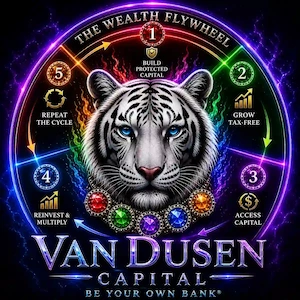
The Wealth Flywheel System is built around five connected movements: build protected capital, grow tax-advantaged, access capital, reinvest and multiply, then repeat the cycle. A max-funded IUL can serve as the foundation for this system because it combines several features that are difficult to find in one place.
First, it provides protection. A properly structured policy includes a death benefit, which can help protect family, business interests, or legacy goals.
Second, it provides growth potential. Cash value can be credited interest based on an index strategy, allowing the policy to participate in positive index movement according to the terms of the policy.
Third, it provides downside protection from direct market loss. The cash value is not invested directly in the stock market, and many IUL strategies include a floor that helps protect against negative index crediting periods.
Fourth, it may provide access. Policy owners may be able to access cash value through policy loans or withdrawals, depending on the policy design and available value.
That combination is what makes max-funded IUL a powerful engine inside The Wealth Flywheel System. It gives capital a place to sit, grow, stay protected, and potentially move.
How Cash Value Works Inside An Indexed Universal Life Policy
Cash value is the part of the policy that gives an IUL its living financial utility. It is the value that can build inside the policy over time and may become available for future access.
When premium is paid into the policy, the insurance company deducts policy charges and costs of insurance. The remaining amount can help build cash value. Over time, that cash value may grow based on the crediting strategy selected inside the policy.
In an IUL, the crediting strategy is commonly linked to an external index. The policy is not directly buying stocks, mutual funds, or index funds. Instead, the policy uses a formula that credits interest based on index movement, subject to caps, participation rates, spreads, floors, and other policy terms.
This is why the policy can offer upside potential without direct market ownership. The owner is not participating in dividends or directly owning the index, but the index movement can influence how interest is credited to the policy.
In The Wealth Flywheel System, cash value is the protected capital base. It is what allows the strategy to move from theory into action.
Why The 0% Floor Matters
One of the biggest reasons people explore Indexed Universal Life is the idea of downside protection. Many IUL strategies include a floor, often described as a 0% floor, which means that if the selected index has a negative crediting period, the policy is not credited negative interest from that index movement.
This does not mean the policy has no costs. Policy charges, cost of insurance, loan interest, and other expenses can still affect the policy. But it does mean the cash value is not directly exposed to the same type of market loss that a brokerage account or index fund would experience.
This protection can be powerful because losses are mathematically difficult to recover from. A 30% loss does not require a 30% gain to get back to even. It requires a larger gain. This is why avoiding deep resets can matter in long-term planning.
For people using The Wealth Flywheel System, the floor helps create stability. It keeps the foundation from being directly dragged down by negative index years, which supports the larger goal of building protected capital before trying to multiply it.
The floor is not magic. It is a policy feature that must be understood in context. But when paired with proper funding and design, it can help support a more stable wealth-building structure.
Understanding MEC Rules (Why Overfunding Must Be Done Carefully)
One of the most important concepts in a max-funded IUL strategy is something called a Modified Endowment Contract, or MEC. This is not a type of policy you choose — it is a tax classification that happens when too much premium is placed into a life insurance policy too quickly.
The IRS created MEC rules to prevent life insurance from being used purely as a tax shelter without maintaining its insurance characteristics. If a policy becomes a MEC, it can still function as life insurance, but the tax advantages related to accessing cash value are changed.
In a properly structured max-funded IUL, the goal is to fund the policy aggressively but intentionally — right up to the limit, without crossing into MEC status. This requires careful design from the beginning, not guesswork later.
This is why professional design matters. The difference between a powerful financial strategy and a misstructured policy can come down to how well these rules are understood and applied.

How Policy Loans Actually Work
One of the most talked-about features of an IUL is the ability to access cash value through policy loans. This is often where people begin to understand how the strategy can be used beyond simple accumulation.
A policy loan is not the same as withdrawing your money from a traditional account. Instead, the insurance company lends you money using your policy’s cash value as collateral. This means your policy can remain in place while you access capital.
This structure is what allows the concept of using capital while still maintaining the policy’s long-term role. However, it is important to understand that loans are not free money. Loan interest may apply, and poor management can impact the policy.
When used responsibly, policy loans can provide flexibility. When used carelessly, they can create risk. The strategy is not about taking loans — it is about using access strategically.
Real-Life Applications Of A Max-Funded IUL Strategy
A max-funded IUL is not designed for one specific use. It is designed to create flexibility. That flexibility can be applied in different ways depending on the individual.
Some individuals use policy access for business opportunities — covering expansion costs, equipment purchases, or short-term capital needs. Others use it for real estate strategies, allowing them to move quickly when opportunities appear.
Some families use it as part of a long-term retirement income strategy, creating an additional layer of flexibility beyond traditional accounts. Others use it simply for stability and protection while still allowing growth.
The key point is not the specific use — it is the ability to choose. That flexibility is what gives the strategy its value when designed properly.
Important Considerations And Risks
A max-funded IUL is not a magic solution, and it should never be presented that way. Like any financial strategy, it comes with considerations that must be understood.
Policy performance depends on proper design, consistent funding, and realistic expectations. Costs, caps, participation rates, and loan structures all matter.
Policy loans must be managed carefully. If loans are taken without a plan and the policy is not maintained, there can be consequences, including reduced benefits or policy lapse.
This is why the strategy must be approached with clarity and discipline, not hype. The goal is long-term structure, not short-term excitement.

How Max-Funded IUL Compares To Traditional Financial Strategies
Many people evaluating Indexed Universal Life are also considering traditional options like 401(k)s, Roth IRAs, brokerage accounts, or savings accounts. Each of these tools can serve a purpose, but they function differently.
A 401(k) or IRA is typically designed for long-term retirement accumulation. These accounts may offer tax advantages, but they often come with contribution limits, access restrictions, and potential exposure to market volatility.
Brokerage accounts provide flexibility and direct market participation, but they also come with full market risk. Gains and losses can be significant, and taxes may apply depending on how the account is used.
A max-funded IUL is structured differently. It is not a direct market investment, and it is not a qualified retirement plan. It is a life insurance policy designed with cash value, protection features, and potential access strategies in mind.
Instead of replacing every financial tool, it can complement an overall strategy by adding protection, flexibility, and an additional layer of capital positioning.
Common Questions And Misunderstandings
Because Indexed Universal Life is often misunderstood, it is important to address some of the most common concerns directly.
⭐ “Is this too good to be true?”
No financial strategy is perfect. IUL has strengths and limitations. The value comes from understanding how it works, not assuming it solves everything.
⭐ “Can I lose money in an IUL?”
The policy is not directly invested in the market, but it still has costs and performance factors. Poor design or mismanagement can impact results.
⭐ “Is this only for wealthy individuals?”
It is often best suited for individuals with consistent income who can fund the policy properly. The strategy requires commitment.
⭐ “Why doesn’t everyone do this?”
Because it requires education, discipline, and proper design. Many people are never introduced to it in a structured way.
Who This Strategy May Be Right For
⭐ Individuals with stable, consistent income
⭐ Business owners or entrepreneurs who value access to capital
⭐ People looking for an additional layer of financial flexibility
⭐ Individuals focused on long-term strategy, not short-term gains
⭐ Those who want to integrate protection and growth into one structure
Who This Strategy May NOT Be Right For
⭐ Individuals looking for quick returns or short-term results
⭐ Those unable to commit to consistent funding
⭐ People who prefer direct market investing without insurance structure
⭐ Anyone looking for a “set it and forget it” strategy without involvement
Take Control of Your Financial Strategy
Build protected capital, grow it tax-efficiently, access it when you need it, and create long-term momentum using the Wealth Flywheel System.
