
Indexed Growth Explained: A Simple Guide to How IUL Growth Works
Indexed growth is one of the most important concepts to understand before considering an Indexed Universal Life policy. It is also one of the most misunderstood.
Many people hear the word “indexed” and assume their money is directly invested in the stock market. That is not how an IUL works. An Indexed Universal Life policy does not place your cash value directly into an index like the S&P 500. Instead, the policy uses the performance of a market index as a reference point to determine how interest may be credited to the policy.
That difference matters. Indexed growth is not the same as owning stocks, ETFs, or mutual funds. It is a crediting method inside a life insurance policy. The strategy is designed to provide growth potential while also offering protection from direct market losses through features like a 0% floor, depending on policy design and carrier terms.
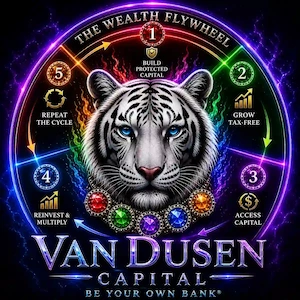
At Van Dusen Capital, indexed growth is explained as one part of The Wealth Flywheel System: build protected capital, grow tax-advantaged value, access capital strategically, reinvest when appropriate, and repeat the cycle over time.
The Simple Definition
Indexed growth means your policy’s interest crediting is linked to the performance of a market index, but your money is not directly invested in that index.
The index acts like a measuring stick. The policy uses that measuring stick to decide how much interest may be credited, subject to caps, participation rates, spreads, floors, and other policy rules.
Understand Indexed Growth Before You Start
Indexed growth can be powerful when it is understood correctly. The goal is not hype — the goal is clarity, structure, and knowing how the policy actually credits interest.
Van Dusen Capital can help you understand how indexed growth may fit inside The Wealth Flywheel System and your long-term strategy.
How Indexed Interest Is Credited (Step-by-Step)
Indexed crediting is formula-based. The insurer looks at an external index over a defined period and then applies policy rules to determine the credited interest.
Step 1 — Choose an Index Strategy
Examples include annual point-to-point or monthly averaging. Each method measures index performance differently.
Step 2 — Measure the Index
The index’s change (e.g., start vs. end value) is calculated for the period.
Step 3 — Apply Policy Rules
Caps, participation rates, or spreads adjust the raw index return.
Step 4 — Apply the Floor
If the result is negative, a floor (often 0%) may limit downside for that period.
Step 5 — Credit Interest
The final rate is credited to the policy’s cash value (subject to policy charges and terms).
These steps repeat each crediting period, creating a series of annual (or periodic) outcomes rather than one continuous market return.
Simple Examples: Caps, Participation, and Floors
Below are simplified examples to illustrate how policy rules can affect credited interest. These are hypothetical and for educational purposes only.
These mechanics explain why indexed growth is often described as “participating in a portion of the upside with protection against negative periods,” subject to policy design.
Cap vs Participation Rate: What Actually Matters More?
Two of the most important levers in indexed growth are caps and participation rates. Understanding how they differ helps you evaluate policy design more effectively.
Cap Example:
Index returns 15%
Cap = 9%
Credited = 9%
Participation Example:
Index returns 15%
Participation = 70%
Credited = 10.5%
Different policies emphasize different levers. Strong policy design is about how these variables work together over time—not just one number in isolation.
Why Volatility Can Work Differently in Indexed Strategies
Volatility is usually seen as risk in traditional investing. In indexed crediting, volatility can interact differently because negative years may not be credited as losses (subject to the policy floor).
Market Path A: +10%, -10%, +10%
Market Path B: +5%, +5%, +5%
Even if average returns look similar, the sequence and structure can produce different outcomes depending on how crediting works.
This is why understanding the mechanics—not just averages—is critical.
The Role of the 0% Floor and Volatility
A commonly discussed feature is the floor (often 0%). When applicable, it can limit negative credited interest for a given period—even if the index declines.
Over multiple years, avoiding negative crediting periods can change the sequence of returns, which may influence long-term compounding compared to directly experiencing market drawdowns.
Year 1: +10% → credited (subject to rules)
Year 2: -12% → 0% (if floor applies)
Year 3: +8% → credited
This illustrates how floors can alter the pattern of returns over time. Actual results depend on policy terms, charges, and crediting methods.
Sequence of Returns Risk: Why Timing Matters
Sequence of returns risk refers to the order in which gains and losses occur. Two portfolios with the same average return can produce very different outcomes depending on when losses occur.
Scenario A: Loss occurs early
Scenario B: Loss occurs later
Even with the same average return, Scenario A may result in a lower ending balance due to early losses impacting compounding.
This is one reason some strategies focus on reducing downside exposure during critical compounding years.
The Tradeoff: Upside Limits vs Downside Protection
Indexed strategies involve tradeoffs. Caps and participation rates may limit upside relative to direct investing, while floors may limit downside for a given period.
✔ Potential participation in positive index periods (subject to limits)
✔ Potential protection from negative credited interest periods (subject to floor)
✔ Outcomes depend on policy design, charges, and crediting methods
Understanding these tradeoffs is essential before evaluating whether indexed crediting aligns with your objectives and risk preferences.
Why Policy Design Matters More Than the Index Itself
Many people focus only on the index being used. In reality, the policy design often has a greater impact on long-term performance than the index itself.
✔ Cap levels and participation rates
✔ Fee structure and cost efficiency
✔ Overfunding strategy
✔ Crediting method selection
Two policies using the same index can produce very different outcomes depending on how they are structured.
Two Policies, Same Index — Different Outcomes
Not all IUL policies are designed the same. Even when using the same index, outcomes can vary significantly based on structure.
The index is only one piece. Structure determines performance.
Long-Term Illustration (Conceptual)
Over longer periods, results are driven by sequences of credited rates rather than a single average return.
These simplified figures show how rules shape credited results across different periods.
Realistic Multi-Year Example: How Indexed Growth Compounds Over Time
To understand indexed growth, you have to look at multiple years—not just one. Growth is built from a sequence of credited rates, not a single return.
This example shows how avoiding negative years and capturing portions of positive years can influence long-term growth. Actual results vary based on policy design and charges.
The Power of Compounding Without Negative Years (Conceptual)
Compounding is not just about average returns—it is about what happens in down years. Negative returns can significantly impact long-term outcomes because losses require larger gains to recover.
Example:
$100,000 → -20% = $80,000
$80,000 → +25% = $100,000
A 20% loss requires a 25% gain just to break even.
This is why the sequence of returns matters. Avoiding or reducing negative years (depending on policy structure) can change long-term compounding behavior.
Indexed strategies attempt to address this concept by limiting downside crediting in certain periods, while still allowing participation in positive periods, subject to caps and policy rules.
Common Misunderstandings About Indexed Growth
✖ “It tracks the market exactly” — It does not; rules apply.
✖ “There is no downside risk at all” — Floors apply to credited interest for the period, but policy performance also depends on charges and other factors.
✖ “Returns are guaranteed” — Credited rates depend on index performance and policy terms.
Clarity on these points helps set realistic expectations and better decision-making.
Where Indexed Growth Fits in a Strategy
Indexed crediting is typically one component within a broader financial strategy. It is often evaluated alongside other tools depending on objectives, time horizon, and risk tolerance.
Within The Wealth Flywheel System, indexed growth is associated with building and compounding value over time, while maintaining flexibility for how capital may be accessed and used, subject to policy design.
Any strategy should be reviewed in the context of overall financial planning, including tax considerations, liquidity needs, and long-term goals.
What Most People Are Never Told About Indexed Growth
Indexed growth is not a shortcut. It is not a magic return. It is a structured system with tradeoffs, rules, and long-term implications.
✔ Caps can limit upside in strong years
✔ Participation rates impact credited returns
✔ Fees and design affect long-term outcomes
✔ Overfunding strategy matters significantly
The difference between a policy and a strategy is how it is designed, funded, and used over time.
Additional Educational Resources
For further reading on how indexed universal life policies work, review these external resources:
IRS — Life Insurance Tax Treatment
Investopedia — Indexed Universal Life (IUL)
NAIC — Insurance Consumer Resources
Build Your Strategy with Clarity
Indexed growth is not about shortcuts—it is about understanding how crediting works and how it may fit within a structured plan.
If you want to explore how indexed crediting may align with your goals, the next step is a personalized strategy review.